| ||||||||||||||
| ||||||||||||||
|
Home l About l Programs l Training l Diary l Tourism l Contacts |
||||||||||||||
|
|



|
|
|
|
|

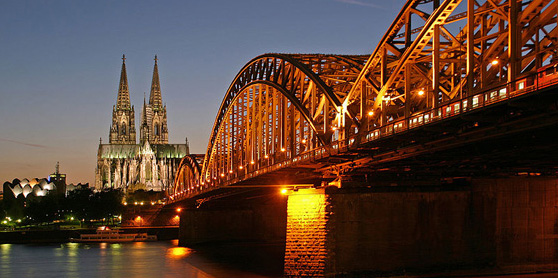
Cologne (German: Köln), is Germany's fourth-largest city after Berlin, Hamburg and Munich, and is the largest city both in the German Federal State of North Rhine-Westphalia and within the Rhine-Ruhr Metropolitan Area, one of the major European metropolitan areas with more than ten million inhabitants. It is one of the oldest cities in Germany, having been founded by the Romans in the year 38 BC. Cologne was granted the status of a Roman "city" in the year 50 AD.
Cologne lies on the River Rhine. The city's famous Cologne Cathedral (Kölner Dom) is the seat of the Roman Catholic Archbishop of Cologne. The University of Cologne (Universität zu Köln) is one of Europe's oldest universities.
Cologne is a major cultural center of the Rhineland and has a vibrant arts scene. Cologne is home to more than 30 museums and hundreds of galleries. Exhibitions range from local ancient Roman archeological sites to contemporary graphics and sculpture. The city's Trade Fair Grounds are host to a number of trade shows such as the Art Cologne Fair, the International Furniture Fair (IMM) and the Photokina. Cologne is also well-known for its celebration of Cologne Carnival, the annual reggae summer-jam, the largest of its kind in Europe, and the LGBT festival Christopher Street Day (CSD).
Within Germany, Cologne is known as an important media center. Several radio and television stations, including Westdeutscher Rundfunk (WDR), RTL and VOX (TV channel), are based in the city. The city also hosts the Cologne Comedy Festival, which is considered to be the largest comedy festival in mainland Europe. In 2005 Cologne hosted the 20th Roman Catholic World Youth Day with Pope Benedict XVI. It was one of the largest-ever meetings, with over a million participants.
For more info about Cologne; please visit: http://en.wikipedia.org/wiki/Cologne
Hanover (German: Hannover) on the river Leine, is the capital of the federal state of Lower Saxony (Niedersachsen), Germany and was once by personal union the family seat of the Hanoverian Kings of Great Britain, in their dignities as the dukes of Brunswick-Lüneburg (which title was later called the Elector of Hanover at the end of the historical period known as Early Modern Europe). After the Napoleonic Wars ended, the Electorate was enlarged and made into the capital of the Kingdom of Hanover.
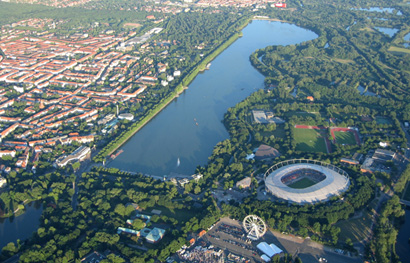
In addition to being the capital of Lower Saxony, Hanover was the capital of the administrative area Regierungsbezirk Hannover (Hanover region) until Lower Saxony's administrative regions were disbanded at the beginning of 2005. It is, however, still part of the Hanover district (Region Hannover), which is a municipal body made up from the former district and city of Hanover.
With a population of 522,944 (1 February 2007) the city is a major center of northern Germany, known for hosting annual commercial expositions such as the Hanover Fair and the CeBIT. Every year Hanover hosts the Schützenfest Hannover, the world's largest Marksmen's Fun Fair, and the Oktoberfest Hannover, which is the second largest Oktoberfest in the world. In 2000, Hanover hosted the world fair Expo 2000. The Hanover fairground, due to numerous extensions especially for the Expo 2000, is the largest in the world. Hanover also has regional importance because of its universities and medical school, its international airport, and its large zoo.
For more info about Hanover - Germany; please visit: http://en.wikipedia.org/wiki/Hanover

Vienna (German: Wien) is the capital of Austria, and is also one of the nine states of Austria. Vienna is Austria's primary city; with a population of about 1.7 million (2.3 million within the metropolitan area), it is by far the largest city in Austria as well as its cultural, economic, and political center. It is the 10th largest city by population in the European Union and was listed by Mercer Human Resource Consulting as having the 2nd highest quality of living (as of 2008).
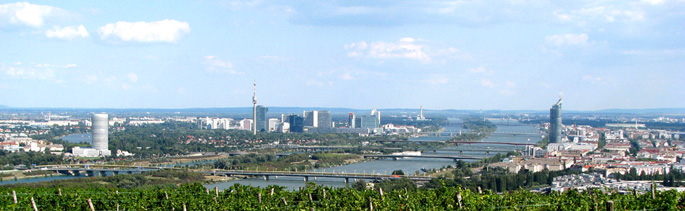
Vienna is host to many major international organizations such as the United Nations and OPEC. Vienna lies in the very east of Austria and is close to the Czech Republic, Slovakia and Hungary. In 2001, the city centre was designated a UNESCO World Heritage Site and an Economist Intelligence Unit study of 127 world cities ranked it first equal with Vancouver for the quality of life.
For more info about Vienna - Austria; please visit: http://en.wikipedia.org/wiki/Vienna
–
Graz "little castle", with a population of around 290,000 as of 2008 (of which 252,852 have principal residence status), is the second-largest city in Austria after Vienna and the capital of the federal state of Styria. The city is situated on the Mur river, in the south east of Austria. It is approximately 200 km southwest of Vienna or 2.5 hours by train / 2 hours by car. The nearest larger urban center is Maribor in Slovenia which is about 50 km away. Graz is the capital and largest city in Styria.
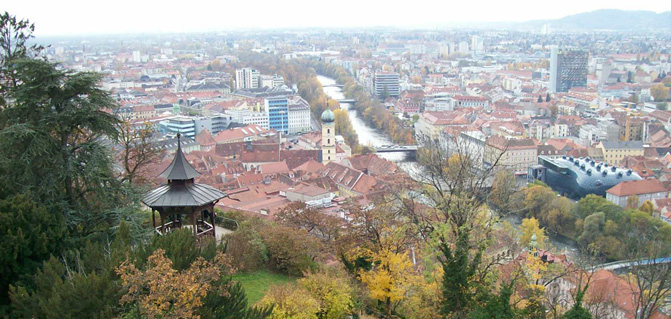
Graz has a long tradition as a students' city: its 6 Universities have over 44,000 students. Graz's "Old Town" is one of the best-preserved city centers in Central Europe. In 1999, it was added to the UNESCO list of World Cultural Heritage Sites. Graz was sole Cultural Capital of Europe for 2003.
Coming to Graz is the beginning of a new friendship. There is an immediate sense of familiarity and the alleys and squares, impressive buildings, museums and galleries make you want to find out more about this city at the crossroads of cultures.
For more info about Graz - Austria; please visit: http://en.wikipedia.org/wiki/Graz
Innsbruck is the capital city of the federal state of Tyrol in western Austria. It is located in the Inn Valley at the junction with the Wipptal (Sill River), which provides access to the Brenner Pass, some 30 km south of Innsbruck. Located in the broad valley between high mountains, the Nordkette (Hafelekar, 2,334 m) in the north, Patscherkofel (2,246 m) and Serles (2,718 m) in the south, it is an internationally renowned winter sports centre, and hosted the 1964 and 1976 Winter Olympics. The word bruck comes from the German word Brücke meaning "bridge" which leads to "the bridge over the Inn".
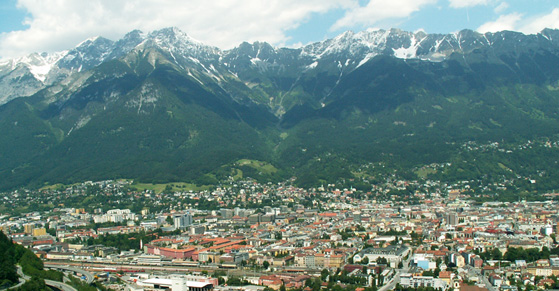
Innsbruck is a famous University city. Also it is the cultural
and economic center of western Austria and is one of the most
famous and substantial tourist centers, with more than a
million overnight stays.
In Innsbruck there are 78,000 employees and about 8,000
places of work. About 35,000 people shuttle every day into
Innsbruck. Tourism is the most important source of income for
the city authority, largely because of Innsbruck's beautiful
town centre with its historic buildings, the friendly ambience
and the
extensive sport facilities both in winter and in summer.
For more info about Innsbruck - Austria; please visit: http://en.wikipedia.org/wiki/Innsbruck

Hamilton (2006 population 504,559; UA population 647,634; CMA population 692,911) is a port city in the Canadian province of Ontario. Conceived by George Hamilton when he purchased the Durand farm shortly after the War of 1812, Hamilton has become the centre of a densely populated and industrialized region at the west end of Lake Ontario known as the Golden Horseshoe. On January 1, 2001 the new City of Hamilton was formed through amalgamation of the former City with the constituent towns of the Hamilton-Wentworth Regional Municipality. Residents of the city are known as Hamiltonians. Since 1981, the metropolitan area has been listed as the ninth largest in Canada and the third largest in Ontario.
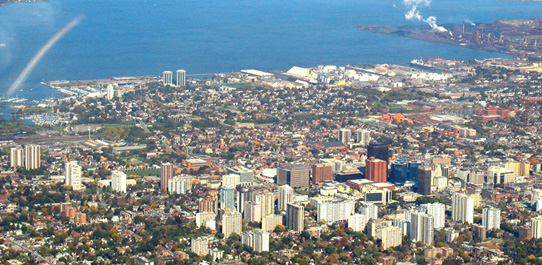
Traditionally, the local economy has been led by the steel and
heavy manufacturing industries. Within the last decade, there
has been a shift towards the service sector, particularly
health sciences. The Hamilton Health Sciences corporation
employs nearly 10,000 staff and serves approximately 2.2
million people in the region.
Hamilton is home to the Royal Botanical Gardens, the Canadian
Warplane Heritage Museum, the Bruce Trail, McMaster University
and several colleges. The Canadian Football Hall of Fame can
be found downtown right beside Hamilton City Hall and across
town to the east, the Canadian Football League's Hamilton
Tiger-Cats play at Ivor Wynne Stadium. Partly because of its
diverse locations, numerous TV and film productions have been
filmed in Hamilton, regulated by the Hamilton Film and
Television Office.
A growing arts and culture sector garnered media attention in a 2006 Globe and Mail news article, entitled "Go West, Young Artist," which focused on the growing art scene in Hamilton. The article highlighted local art galleries, recording studios and independent film production.
For more info about Hamilton - Canada; please visit: http://en.wikipedia.org/wiki/Hamilton,_Ontario

Gdańsk is the city at the center of the fourth-largest
metropolitan area in Poland. It is Poland's principal seaport
as well as the capital of the Pomeranian Voivodeship. It is
also historically the largest city of the Kashubian region.
The city lies on the southern edge of Gdańsk Bay (of the
Baltic Sea), in a conurbation with the spa town of Sopot, the
city of Gdynia and suburban communities, which together form a
metropolitan area called the Tricity (Trójmiasto), with a
population of over 800,000. Gdańsk itself has a population of
458,053 (2006), making it the largest city in the Pomerania
region of Northern Poland.
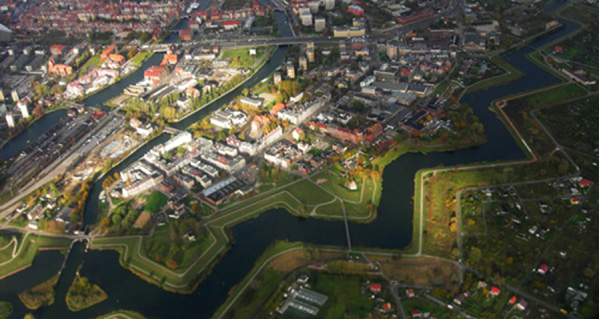
Gdańsk is situated at the mouth of the Motława River,
connected to the Leniwka, a branch in the delta of the nearby
Vistula River, whose waterway system waters 60% of the area of
Poland and connects Gdańsk to the national capital in Warsaw.
This gives the city a unique advantage as the center of
Poland's sea trade. Together with the nearby port of Gdynia,
Gdańsk is also an important industrial center. Historically an
important seaport and shipbuilding center, Gdańsk was a member
of the Hanseatic League.
The city was the birthplace of the Solidarity movement which,
under the leadership of Gdańsk political activist Lech Wałęsa,
played a major role in bringing an end to communist rule
across Central Europe.
For more info about Gdansk - Poland; please visit: http://en.wikipedia.org/wiki/Gdansk

Iaşi is a city and municipality in north-eastern Romania. The city was the capital of Moldavia from the 16th century until 1861 and of Romania (Romanian Kingdom) between 1916–1918 during World War I.
The city of Iaşi lies on the Bahlui River, a tributary of the Jijia (tributary of the Prut). The surrounding country is one of uplands and woods, featuring the monasteries of Cetăţuia, Frumoasa, Galata (with nearby mineral springs), and the dendrologic park of Repedea. Iaşi itself stands amid vineyards and gardens, partly on two hills, partly in the in-between valley. It is a common belief that Iaşi is built on seven hills (coline in Romanian): Cetăţuia, Galata, Copou- Aurora, Bucium-Păun, Şorogari, Repedea and Breazu, thus triggering comparisons with Rome, la città dei sette colli (The city of the seven hills). The city is a metropolitan area, expanding its territory with 10 other communities surrounding the city.
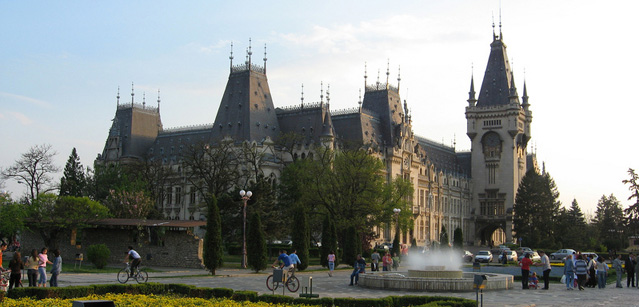
The second largest Romanian city, Iaşi is the economic, cultural and academic centre of the Romanian region of Moldavia. The city has the oldest Romanian university and accommodates an annual count of over 60,000 students in 5 public and 3 private universities. It is home to more than 50 churches and hosts 5 cultural centres: British, French, German, Latin American & Caribbean and Hellenic. Cultural life gravitates around the National Theater (the oldest in Romania), the Opera House, the Iaşi State Philarmonic, the Tătăraşi Atheneum, a famous Botanical Garden (the oldest and largest in Romania), the Central University Library (the oldest in Romania), an array of museums and memorial houses, an independent theater and several student organizations.
For more info about Iasi - Romania; please visit: http://en.wikipedia.org/wiki/Iasi

Wenzhou is a prefecture-level city in southeastern Zhejiang province of the People's Republic of China. It has a population of 7,645,700 in 2007, with 1,423,600 residents in the urban area of the city. It also administers 2 satellite cities and 6 counties. It borders Lishui to the west, Taizhou to the north, and looks out to the East China Sea to the east.
Wenzhou derives the present name from its mild climate. Known as "Ou" in ancient times, it was the capital of the Kingdom of East Ou in192BC.In138 it began as Yongning County and in 323 developed into Yongjia Prefecture. It was also called" the City of White Deer" because, according to the legend, when the city was rebuilt a white deer passed round it holding a flower in the mouth, which implies good fortune. In 675 it began to be named Wenzhou and continues to be so called up to now.
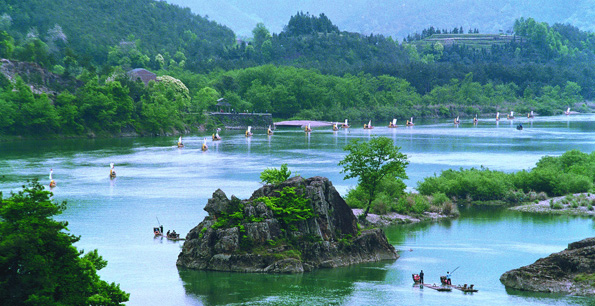
Facing the sea with hills behind, Wenzhou has long been reputed as "a land having the finest scenery in the world". It boasts wonderful landscapes with numerous grotesque mountains and graceful waters, ranging from the state-designated scenic areas e.g. the Yandang Mountain and the Nanxi River, the state- designated natural protected areas e.g. the Wuyanling Ridge and the Nanji Islands and the 9 provincial-designated scenic areas the Xianyan Cliff, the Yaoxi Stream, the Zeya Mountain,the Binghai-Yucang Mountain, the Dongtou Island, the Zhailiaoxi Stream and the Baizhangji Waterfall to the 10-odd municipal and county-designated scenic areas,such as the Chashan Mountain, the Mingang Ridge and the Tianzhu Temple.
Wenzhou was a prosperous foreign treaty port, which remains well-preserved today. It is situated in a very mountainous region and, as a result, have been isolated for most of its history from the rest of the country, making the local culture and language very different from those of neighboring areas. It is also known for its emigrants who leave their native land for Europe and the United States, with a reputation for being enterprising natives who start restaurants, retail and wholesale businesses in their countries.
For more info about Wenzhou - China; please visit: http://en.wikipedia.org/wiki/Wenzhou
Home l About l Programs l Training l Diary l Tourism l Contacts
Copyrights © 2007 - Egyptian Association For International Medical Studies (EAIMS)